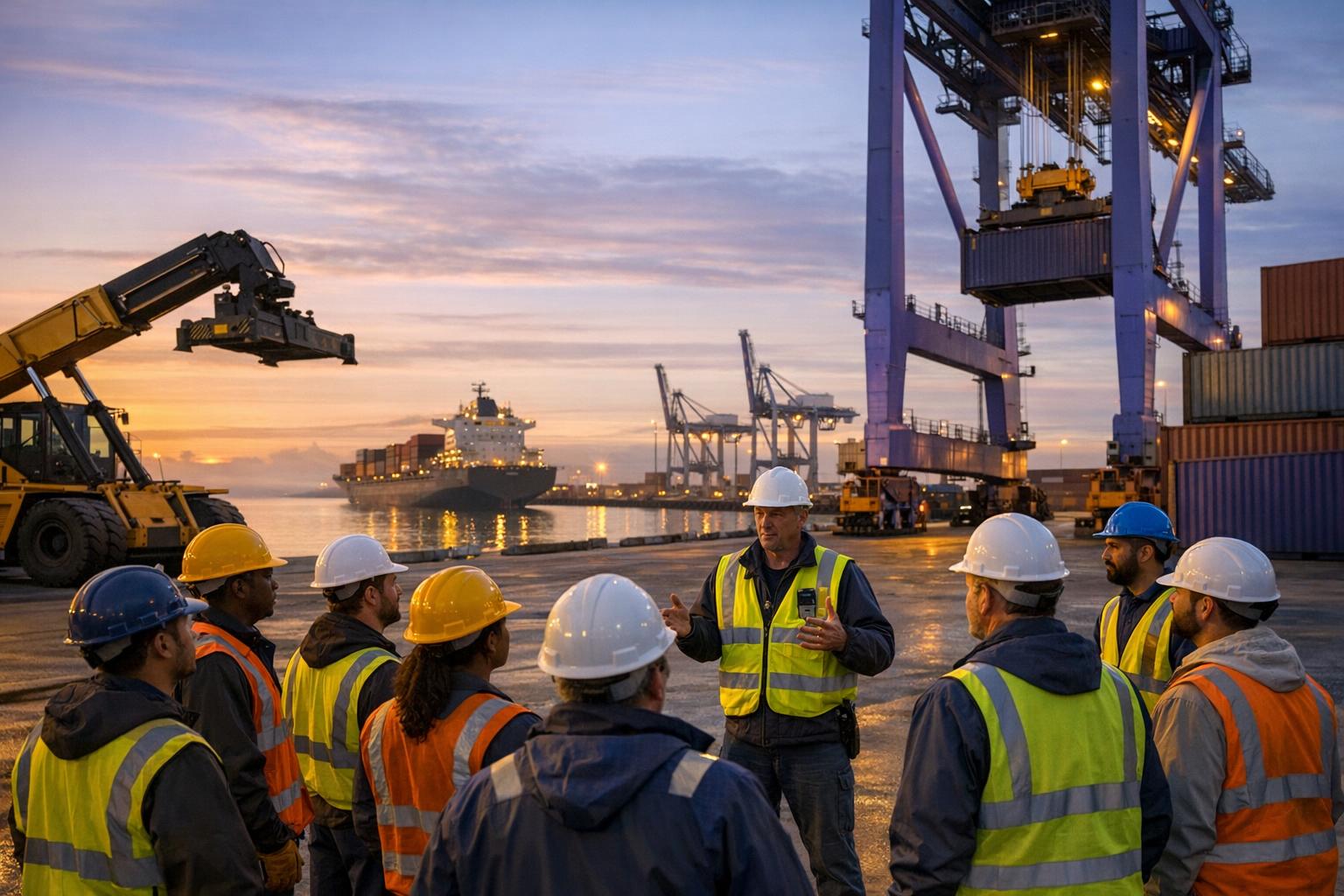
Why port staffing safety has to start before the first shift
Port operations are not interchangeable with ordinary warehouse or industrial work. OSHA’s maritime guidance treats longshoring and marine terminals as high-risk environments that combine moving vehicles, suspended cargo, changing walking surfaces, vessel interfaces, and water exposure. In practice, that means hiring decisions affect safety outcomes well before a worker clocks in.
The case for tighter screening and onboarding is reinforced by federal injury data summarized by CDC/NIOSH. Using six-year-average data for 2011 through 2017, NIOSH estimated 98,267 workers in marine terminals and port operations, with a fatal injury rate of 15.9 per 100,000 workers and a nonfatal injury and illness rate of 4,916.0 per 100,000 workers. NIOSH describes the fatality rate for marine terminals and port operations as about five times the overall U.S. workforce rate. Those figures are historical averages rather than current-year counts, but they show why safety cannot be treated as a generic orientation topic.
For staffing partners and employers, the operational takeaway is simple: port staffing safety depends on placing people into roles they are prepared to perform, with clear hazard communication, task-specific qualifications, and site rules established up front rather than after an incident or near miss.
The hazards that shape port and marine hiring
OSHA’s fatal-facts material for longshoring and marine terminals groups the most serious incidents into three broad categories: vehicle-related events, falls and drowning, and material-handling failures. OSHA describes vehicle incidents as the most frequent cause in that training material, followed by falls or drowning. That makes traffic exposure a staffing issue as much as a compliance issue, especially where trucks, forklifts, container handlers, front-end loaders, and pedestrians share space.
Material-handling hazards are equally important in hiring and assignment decisions. OSHA highlights unstable cargo, poorly secured loads, and workers positioned under suspended loads as recurring causes of serious harm. In a port setting, a candidate may be fully capable in a general industrial role but still be unready for work around cranes, chassis, twist locks, container stacks, or active vessel loading zones.
Port-side warehouse work adds another layer. OSHA’s warehousing overview identifies powered industrial trucks, ergonomics, material handling, hazardous chemicals, slips and trips, and robotics as core hazards. For coastal employers, these risks often overlap with marine-terminal conditions rather than replacing them, which is why job descriptions and pre-start instruction need to be more specific than 'forklift experience preferred.'
What employers should build into onboarding and daily operations
OSHA’s longshoring and marine terminal guidance emphasizes training employees for the jobs they actually perform and reinforcing hazard awareness through an effective safety and health program. That standard is especially relevant in temporary, seasonal, surge, and multi-employer port environments, where workers may move between tasks, crews, and pieces of equipment over a short period.
One of the clearest priorities is separating people from moving equipment. OSHA’s marine-terminal resources point employers to formal traffic safety measures such as designated vehicle routes, pedestrian controls, communication rules, visibility practices, and safer backing procedures. In staffing terms, that means workers need to know not only how to do the job, but how the site manages right-of-way, restricted zones, and entry into active operating areas.
OSHA’s maritime resources also support a concrete approach to struck-by and caught-between prevention: inspect cargo and equipment before use, verify load stability, and keep workers out from under suspended or inadequately secured loads. Employers who want safer starts should translate those principles into observable expectations during orientation, toolbox talks, and supervisor check-ins rather than relying on broad statements that safety is a company value.
Shipyard and vessel-interface work demand tighter controls
Many coastal employers hire across terminals, docks, repair facilities, and shipyards, but the hazard profile changes sharply once work involves vessel construction, repair, or enclosed spaces. OSHA’s shipyard guidance and eTools address falls from edges and openings, scaffold risks, hot work, electrical hazards, hazardous substances, and confined or enclosed spaces. These are not secondary concerns; OSHA identifies fall hazards as a leading cause of shipyard fatalities in its shipyard materials.
That matters for recruiting because availability is not the same as readiness. Workers assigned to shipyard or vessel-adjacent tasks may need instruction tied to deck openings, access routes, welding or hot-work controls, and changing surface conditions. OSHA also states that workers entering shipyard confined spaces must be trained on the hazards, entry procedures, safe work practices, and emergency measures required under 29 CFR 1915.12(d).
A practical staffing process should therefore verify not just trade skill, but the worker’s fit for the exact environment: marine terminal, warehouse, fabrication area, dry dock, repair berth, or confined-space task. The safer and more efficient approach is to match labor to exposure levels, supervision needs, and required training before assignment.
How a safety-led staffing model helps coastal employers hire better
For Southeast port operators, marine contractors, and logistics businesses, the strongest safety message is also a recruiting message: be specific. Candidates and clients both benefit when employers spell out whether a role involves forklift traffic, gangways, deck edges, suspended loads, confined spaces, hazardous chemicals, hot work, or work near the water. Clear expectations improve placement quality and reduce the odds of putting a worker into a preventable mismatch.
OSHA’s current training and outreach resources give employers a practical framework. Marine-terminal and longshoring courses listed by OSHA cover standards, cargo-handling gear, vessel operations, working surfaces, personal protective equipment, enforcement, and recordkeeping. That does not replace site-specific training, but it underscores a broader point: safe port staffing is built on documented processes, competent supervision, and training that reflects the real jobsite.
For a staffing brand serving coastal industries, port staffing safety should mean more than filling openings quickly. It should mean confirming the task, the exposure, the equipment, the training need, and the stop-work expectations before the assignment begins. In a port environment, that is not administrative overhead; it is part of operating responsibly.
Port employers do not need broader safety slogans; they need sharper staffing decisions. When hiring and onboarding reflect OSHA’s documented hazard patterns in marine terminals, warehouses, and shipyards, employers are better positioned to protect workers, support supervisors, and keep operations moving.
Sources
- Longshoring and Marine Terminal Industries - OSHA 2015-10-09
- Longshoring and Marine Terminals: Fatal Facts 2026-08-12
- Warehousing - Overview | Occupational Safety and Health ... 2026-08-26
- Further Assistance 2004-02-01
- Maritime - Information and Guidance for Shipyard Employment - OSHA 2026-07-08
- View All Courses By Title and Description | Occupational Safety and ... 2026-08-26