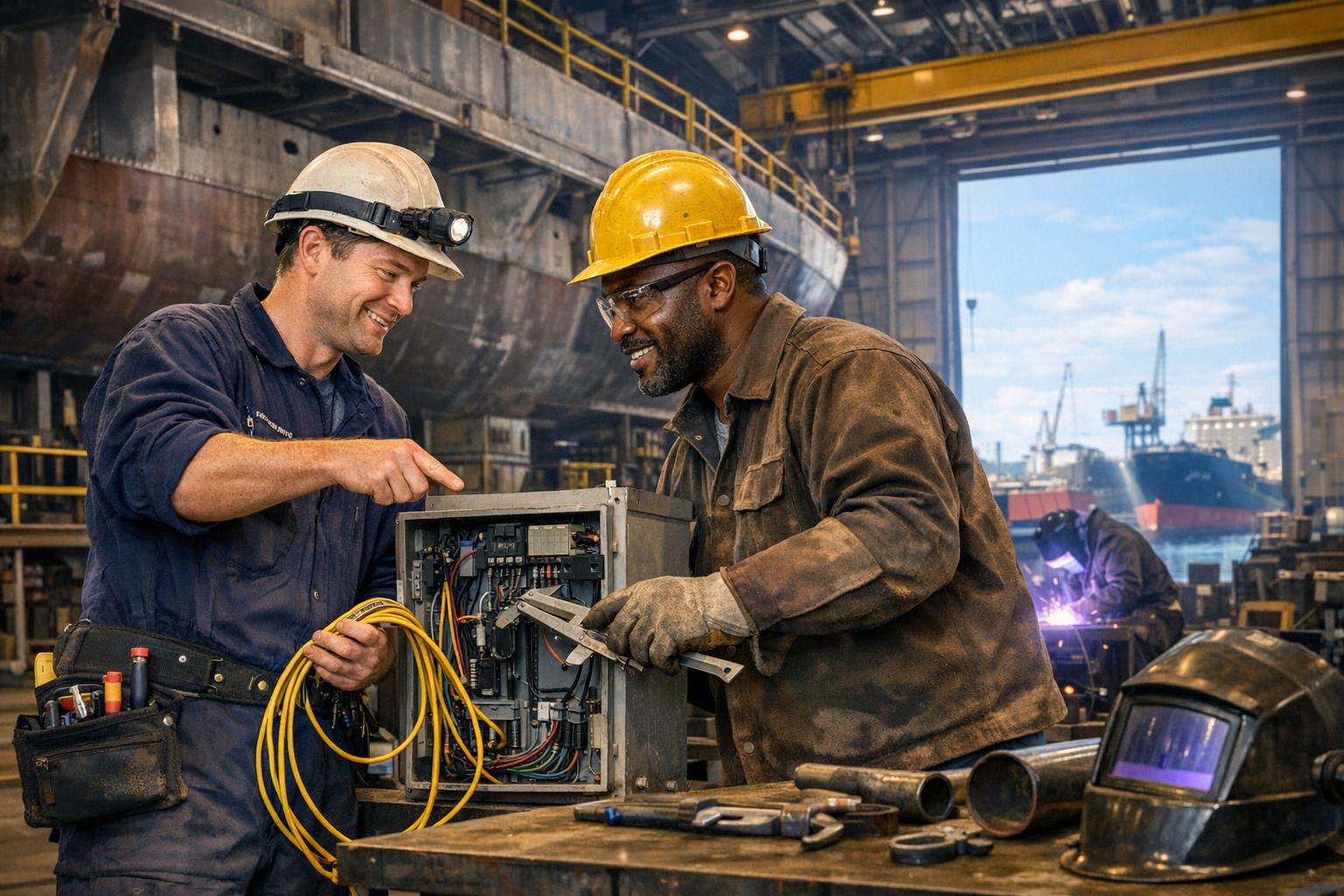
Shipyard staffing starts with a small set of hard-to-replace skills
For coastal employers, shipyard staffing is rarely about filling one generic marine trades opening. The harder challenge is securing workers whose skills transfer across vessel construction, repair, fabrication, dockside service, and industrial maintenance. The strongest evidence points to four role families that matter most in recruiting conversations: electricians, welders, shipfitter-related metal layout and fitting talent, and marine service technicians.
Among those groups, electricians stand out as the clearest broad-market pressure point. The U.S. Bureau of Labor Statistics projects 821,000 electricians employed in 2025, rising to 896,900 by 2035, a 9.2% increase, with 72,700 annual openings on average over the decade. That scale matters for shipyards because marine employers are competing for talent against much larger construction and industrial labor markets.
Welders remain essential even though the national growth rate is slower. BLS projects 437,700 welders, cutters, solderers, and brazers in 2025 and 448,100 in 2035, a 2.4% increase, with 40,300 annual openings. In practical recruiting terms, that looks less like a surge occupation and more like a high-volume replacement market where experienced workers continue to cycle out and need to be replaced.
Electricians are a top-priority marine hire because demand extends far beyond shipyards
If a shipyard is struggling to hire marine electricians, national labor data helps explain why. Electricians have the strongest growth signal among the core trades most relevant to marine work, and BLS also identifies the occupation as one that typically requires an apprenticeship rather than quick entry. That combination can tighten supply, particularly when employers need workers who can handle vessel systems, troubleshooting, and jobsite safety in demanding environments.
The median annual wage for electricians was $63,190 in May 2025, higher than the median listed for welders and structural metal fabricators and fitters in the same BLS projections table. For employers, that does not prove a local shortage by itself, but it does show why compensation, apprenticeship pipelines, and retention planning matter in marine recruiting. Candidates with strong electrical fundamentals may have multiple options across commercial, industrial, and construction settings, not just ship repair or waterfront projects.
For staffing strategy, the takeaway is straightforward: electrical recruiting should begin early, and employers should expect competition from outside maritime industries. Waiting until a vessel availability window opens or a yard workload spikes can leave hiring teams chasing the same talent pool as every other contractor in the region.
Welding is still a volume need, even without rapid projected growth
Welding remains one of the most visible marine trades because so much shipyard output depends on reliable fabrication, repair, and structural work. BLS lists a May 2025 median annual wage of $53,750 for welders, cutters, solderers, and brazers, with typical entry preparation described as moderate-term on-the-job training and a typical education level of high school diploma or equivalent.
That pathway can make welding more accessible than some other skilled trades, but it does not make recruitment easy. BLS still projects about 40,300 annual openings over the 2025 to 2035 period, and its occupational outlook notes that most openings are expected to come from replacement needs rather than fast employment growth. For shipyards, that means proven welding talent may remain consistently hard to source even in a slower-growth national category.
The practical implication for coastal employers is that welding hiring should focus on throughput and screening quality at the same time. A larger annual opening count can create the illusion of abundant labor, yet employers still need candidates who can work to specification, adapt to marine materials and environments, and contribute safely under production schedules.
Shipfitters matter, but the national data has to be handled carefully
Shipfitters are central to many yard operations, but employers should be precise about what the federal data does and does not show. BLS does not publish shipfitters as a standalone occupational projection category. Instead, shipfitters are included within Layout Workers, Metal and Plastic. That broader category is projected at 6,200 jobs in 2025 and 5,900 in 2035, a 3.4% decline, with 500 annual openings.
That does not mean shipfitter demand is falling at the same rate in shipbuilding markets. It means the published federal projection is for a mixed occupation group, not a shipfitter-only forecast. For an evidence-led article or hiring plan, that distinction matters. Employers can reasonably say shipfitters sit inside a limited published category, but they should avoid presenting the entire category trend as a precise forecast for shipfitters alone.
A related BLS industry estimate helps add context. In the Ship and Boat Building industry, structural metal fabricators and fitters accounted for 5,820 jobs in May 2023, with a mean annual wage of $55,990 for that occupation-industry combination. That figure is not a shipfitter count, but it does underline how important metal fabrication and fitting skills remain inside ship and boat building.
Marine technicians are a more geographically concentrated recruiting market
Marine service and repair work is not distributed evenly across the country, which is important for Southeast coastal hiring. Nationally, BLS projects employment for motorboat mechanics and service technicians to rise from 25,000 in 2025 to 26,200 in 2035, a 4.9% increase, with 2,600 annual openings. The occupation typically requires a high school diploma or equivalent and long-term on-the-job training.
State data shows that this talent pool is concentrated in specific markets. In May 2023, Florida had the largest published employment count for motorboat mechanics and service technicians at 4,290 jobs, along with a location quotient of 2.93. BLS also reported particularly high concentrations in Rhode Island, with a 4.85 location quotient and 360 jobs, and in Maine, with a 3.46 location quotient and 330 jobs.
For Southeast employers, Florida’s scale is especially relevant because it points to a large and specialized marine technician labor market. Even so, recruiters should label these figures correctly as May 2023 state estimates rather than current counts or future projections for a specific metro, port, or yard.
What this means for coastal recruiting in the Southeast
The clearest lesson from the federal data is that shipyard staffing works best when employers separate broad-trade competition from marine-specific specialization. Electricians face the strongest national growth and the largest annual openings among the listed occupations, so marine employers should expect fierce competition. Welders remain a steady replacement-driven need. Shipfitter-related roles are critical, but public projections are bundled into a broader classification. Marine technicians are specialized and geographically concentrated, with Florida standing out in published state estimates.
That mix argues for a practical recruiting model: build apprenticeship and training relationships for electricians, maintain active welding pipelines rather than hiring reactively, screen fitting talent carefully because titles and federal categories do not align neatly, and treat marine technician searches as market-specific rather than interchangeable across states. Employers that understand these differences are better positioned to prioritize recruiting spend, compensation strategy, and workforce planning.
Just as importantly, the available federal shipbuilding facility report confirms a substantial U.S. shipbuilding and repair base, but it does not provide a verified occupation-level shortage count for these trades. Recruitment decisions should therefore be anchored in a combination of national labor data and local employer demand, not unsupported claims about exact shipyard labor shortages.
Marine trades recruitment is most effective when shipyards focus on the skills that are both operationally essential and structurally hard to replace. The best-supported priorities are electricians, welders, fitting-related metal trades, and marine technicians, with each requiring a different recruiting strategy under the broader challenge of shipyard staffing.