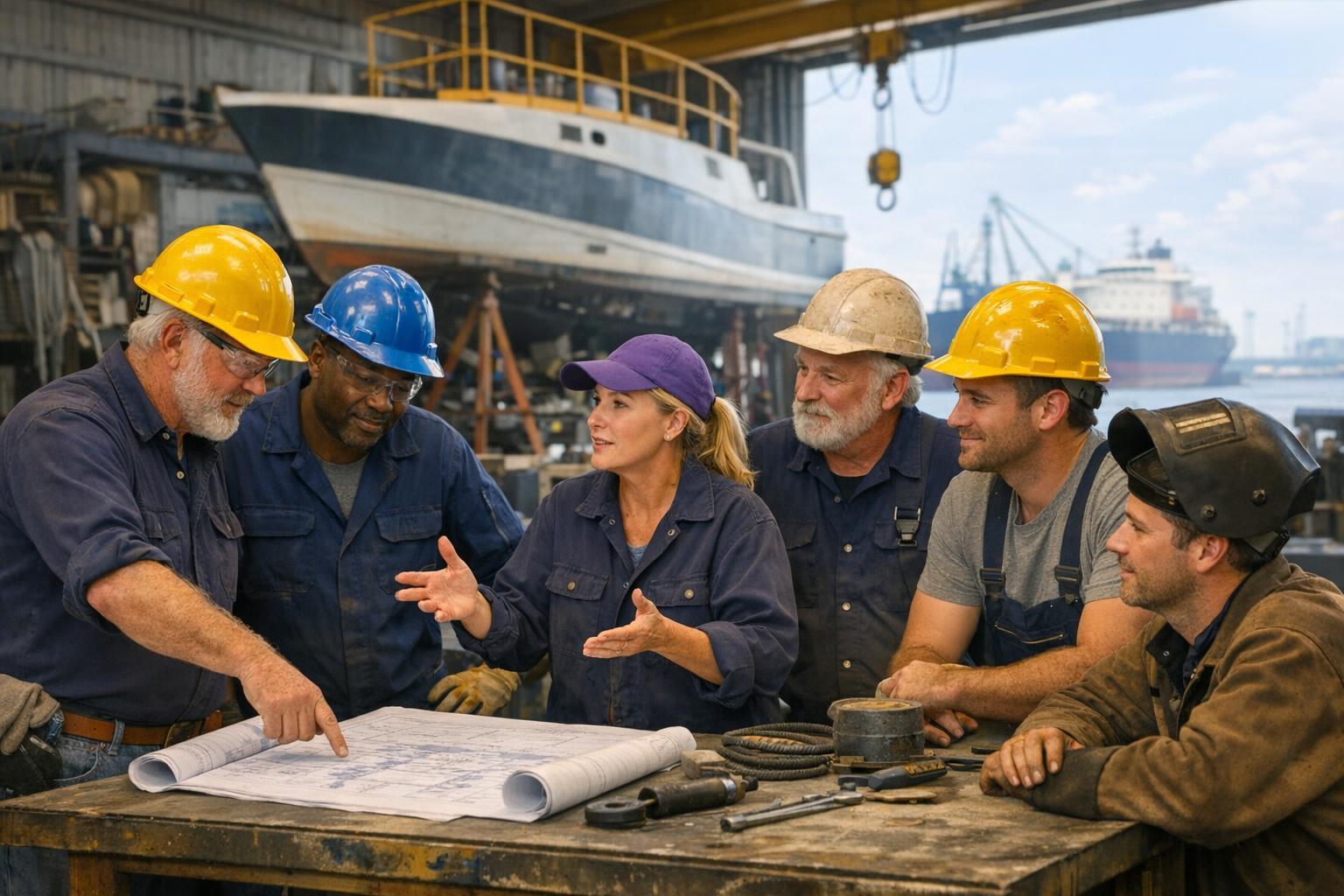
Retention in coastal trades is a job-quality issue before it is a branding issue
For employers along the Southeast coast, the practical challenge is not simply finding welders, riggers, equipment operators, mechanics, drivers, and marine crews. It is keeping them. Federal tenure data offer a useful benchmark: in January 2024, median tenure was 3.4 years in transportation and warehousing, compared with 4.2 years in construction. That does not prove why workers leave, but it does show that transportation-related employers often operate with a shorter worker-employer relationship than construction firms do.
That matters for port operators, marine contractors, and logistics businesses because coastal work often blends the demands of transportation, industrial maintenance, field construction, and waterfront operations. In that environment, marine worker retention is usually built on the daily experience of the job: whether schedules are workable, whether the site feels controlled, whether wages make sense, and whether workers can see a reason to stay for the next skill step rather than leave for the next opening.
The broader benchmark is also instructive. Across all workers, median tenure was 3.9 years, while the private-sector figure was 3.5 years. Transportation and utilities came in at 3.7 years. For coastal employers, that suggests retention planning should be grounded in realistic industry comparisons rather than the assumption that every departure reflects a generalized labor shortage.
Safety is not separate from retention on the waterfront
If employers want a defensible retention strategy, safety belongs near the top. In 2024, transportation and warehousing recorded 261,500 nonfatal injury and illness cases, a rate of 4.4 cases per 100 full-time workers. Construction recorded 167,100 cases, with a rate of 2.2. The gap is hard to ignore: workers in transportation-related environments are seeing a notably higher incidence of reportable harm than workers in construction overall.
Fatality data reinforce the point. Transportation and warehousing recorded 865 fatal work injuries in 2024, with a fatality rate of 12.2 per 100,000 full-time-equivalent workers. Construction recorded 1,034 deaths, but its fatality rate was lower at 9.2. At the occupational level, transportation and material-moving occupations had a fatality rate of 12.5, while construction and extraction occupations were at 12.6. In other words, both talent pools that matter to coastal employers are operating in high-risk environments.
There is also marine-specific evidence worth noting. Deep-sea, coastal, and Great Lakes water transportation posted a total recordable injury-and-illness rate of 4.3 per 100 full-time workers in 2024. BLS subsector data show water transportation at 2.5, truck transportation at 2.9, rail at 3.4, transit and ground passenger transportation at 3.2, and air transportation at 6.2. The figures differ by setting, but the broader lesson is consistent: when workers believe risk is being managed seriously, retention conversations become more credible. When they do not, pay alone may not hold them.
What coastal employers can do now: make the stay decision easier
An evidence-led retention plan does not need to overpromise. It needs to reduce the everyday reasons people leave. For many Southeast coastal employers, that starts with more predictable scheduling where operations allow, especially for workers moving between port calls, yard work, repair jobs, and transportation assignments. A worker who can anticipate hours, overtime expectations, and dispatch patterns is easier to retain than one who feels constantly on call without clear reward.
The second priority is wage clarity. BLS does not publish a single official wage series for "coastal regions," which means employers should avoid broad claims about what coastal labor "should" cost. Instead, the sound approach is to benchmark the specific state, metro, or nonmetro market where the work happens. BLS OEWS publishes employment and wage estimates for states, metropolitan areas, and nonmetropolitan areas, including the transportation, construction, extraction, and repair occupations that coastal firms compete for. For a Charleston, Savannah, Jacksonville, Mobile, or Hampton Roads employer, local comparisons are far more useful than national averages.
Third, employers should show workers what progression looks like. Retention improves when employees can see the next certification, equipment class, vessel assignment, maintenance specialty, or supervisory step. The federal data in hand do not prove that any one training model causes workers to stay longer, but they do support treating skill progression as a serious business variable rather than a soft benefit.
Training pipelines matter, but claims about outcomes should stay disciplined
Apprenticeship is an important workforce tool in skilled trades, marine maintenance, and industrial operations. The U.S. Department of Labor makes state and industry apprenticeship data available, including completion-rate analysis by fiscal year and dashboard reporting on apprentices and completers by state. That gives employers a practical way to assess whether a training pathway is active and measurable in their labor market.
What the available source base does not justify is a simple claim that apprenticeship, by itself, guarantees stronger retention. That kind of statement would require longitudinal employer-level evidence connecting participation to longer tenure or lower turnover. A better editorial conclusion is narrower and more useful: structured training can support recruiting and internal advancement, and employers should evaluate it as an investment with trackable outcomes instead of assuming a payoff.
For coastal businesses, that means measuring whether trainees move into higher-skill assignments, whether wage progression is tied to demonstrated competency, and whether completions translate into more stable staffing on critical shifts. The discipline here matters. Workers tend to stay where growth feels real, but employers still need to verify that result in their own operation.
A realistic retention case for Southeast marine and logistics employers
The strongest argument for marine worker retention in the Southeast is not that one industry has a uniquely severe shortage or that one policy fixes turnover. The stronger argument is that transportation-linked work tends to have shorter tenure, while transportation and marine environments also carry meaningful injury and fatality exposure. In that setting, retention is won by making the job more sustainable.
For employers, that means presenting a straightforward value proposition: competitive local pay, safer worksites, reliable communication, and visible advancement into harder-to-fill skills. For workers, it means evaluating employers on those same terms. A coastal company that wants to keep qualified people should be prepared to show—not merely say—how it protects crews, develops skills, and rewards experience.
That is the practical lesson from the federal data. Keeping skilled coastal workers on the roster is less about rhetoric than about conditions workers can trust shift after shift.
For Southeast coastal employers, retention should be treated as an operating discipline. The available BLS and DOL evidence supports a focus on safer jobs, local wage benchmarking, and credible skill progression. Those are not abstract culture points; they are the practical conditions most likely to make skilled workers stay.
Sources
- OES Home : U.S. Bureau of Labor Statistics 2023-04-25
- Occupational Employment and Wage Statistics (OEWS) Tables 2026-05-15
- May 2025 State Occupational Employment and Wage Estimates 2026-05-15
- Overview of BLS Wage Data by Area and Occupation 2016-02-24
- Occupational Employment and Wage Statistics Overview 2026-05-15